Jeera
Official jeera crop estimate of 1.14m tonnes is double trade figures
Spices Board data put India's 2025-26 cumin output at 1,143,442 tonnes. Trade surveys say about 500,000. The gap sits mostly in Rajasthan.
Published · Data as of · 5 min read
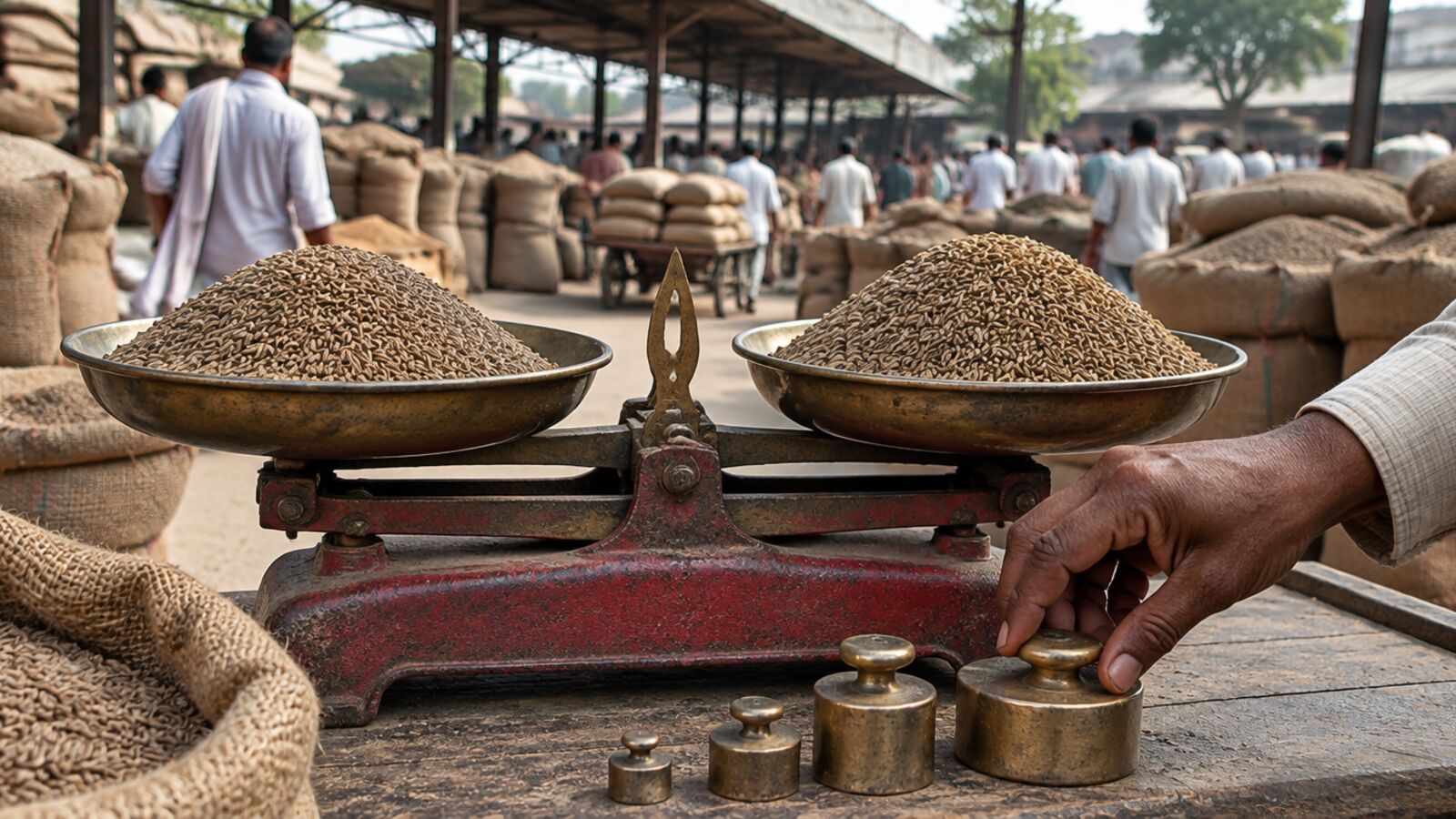
India's official estimate of its 2025-26 jeera (cumin) crop is roughly twice what the trade believes was harvested. The Spices Board India advance estimate, compiled from state agriculture departments and DASD, puts output at 1,143,442 tonnes [1]. Trade surveys reported by BigMint put the same harvest at 495,000 to 540,000 tonnes [2][3].
The gap matters because balance sheets drive prices and hedging. A buyer who uses the official figure sees a market drowning in seed. A buyer who uses the trade numbers sees a tight one, with exports and domestic use absorbing almost the whole crop.
Five estimates for one harvest
| Source | Coverage | Estimate (t) |
|---|---|---|
| Spices Board India, advance estimate [1] | All India, 2025-26 | 1,143,442 |
| International Spice Conference (ISC) [2] | All India, 2026 harvest | 530,000 to 540,000 |
| P. S. Swani, ASTA presentation [4] | Gujarat and Rajasthan, 2026 | 517,000 |
| FISS, via BigMint [2] | Gujarat and Rajasthan, 2026 | 513,130 |
| BigMint [3] | All India, 2026 | 495,000 to 506,000 |
The trade figures cluster within about 10% of each other. The official number is more than double the highest of them (calculated) [1][2]. Commodity Board (CMB News) wrote in November 2026 that last season's crop was about 539,000 tonnes, in line with the trade range [8].
Rajasthan explains most of the difference
The gap runs through both producing states. In Gujarat the Spices Board shows 446,000 tonnes on 450,000 hectares [1]. FISS puts Gujarat at 183,810 tonnes, down 27% [2]. That is a difference of about 262,200 tonnes (calculated).
Rajasthan is where the numbers split. The official series shows 693,939 tonnes from 1,090,000 hectares in 2025-26 [1]. FISS estimates 329,320 tonnes [2]. The difference of about 364,600 tonnes (calculated) is larger than India's entire annual cumin export [1][2][7]. Rajasthan therefore accounts for close to 60% of the total gap between the two series (calculated).
Area is part of the story. Official Rajasthan cumin area jumped to 1,081,550 hectares in 2024-25 from 740,062 hectares in 2023-24 and stayed there [1]. Ajay Kedia told Informist that India's total cumin area peaked at around 1.24 million hectares in 2023-24 [5], while the official all-India figure for that year is 1,302,333 hectares [1]. The official yields also differ by state: about 0.99 tonnes per hectare in Gujarat and 0.64 tonnes in Rajasthan in 2025-26 (calculated) [1].
Units and printing add noise
Trade estimates are usually given in bags. Bag weights vary. Kedia used 50 kg bags in his Informist interview [5]. BigMint's conversion of 1.10 crore bags to about 605,000 tonnes implies about 55 kg a bag (calculated) [3]. Kedia Advisory now puts the crop at 90 to 92 lakh bags against 1.10 crore bags last season [6], which gives 450,000 to 506,000 tonnes depending on the bag size used (calculated).
The official table has its own problem. It prints the 2025-26 all-India cumin area as 154,263 hectares, which cannot be reconciled with the state rows of 450,000 and 1,090,000 hectares [1]. That looks like a misprint, but it shows how little scrutiny the series receives.
A simple disappearance test favours the trade
One check is to add up where the seed goes. India exported 196,800 tonnes of cumin in 2025-26 [7]. Swani's balance sheet puts domestic consumption at 281,000 tonnes a year [4]. Together that is about 478,000 tonnes (calculated), close to the trade crop estimates.
If the official 1,143,442 tonnes were right, India would have added roughly 665,000 tonnes of unsold cumin to stocks in a single year (calculated) [1][4][7]. Trade estimates of carry-forward stocks at the start of 2026 ranged from 137,000 to 165,000 tonnes [2]. Swani put them at 151,000 tonnes [4]. None of the sources reviewed reports stocks on the scale the official figure would imply.
This test does not prove the trade right. Domestic use is itself an estimate. Informist cited a different figure of about 7 million bags [5]. But it explains why traders and analysts rarely use the official number when they price the crop.
What would narrow the gap
Better data would come from crop-cutting results published by Rajasthan and Gujarat or from warehouse stock reports in tonnes. Until then, readers should quote both series: the official figure as a state-reported estimate and the trade figures as survey estimates. The rabi 2026-27 crop, now being sown, will be the next test of whether the two series converge.
Questions and answers
How big was India's cumin crop in 2025-26?
The Spices Board advance estimate is 1,143,442 tonnes [1]. Trade surveys including FISS and the International Spice Conference put the 2026 harvest at about 513,000 to 540,000 tonnes [2].
Why do cumin crop estimates differ so much?
Most of the gap is in Rajasthan, where the official series shows 693,939 tonnes and the FISS survey 329,320 tonnes [1][2]. Differences in area data, yields and bag weights used to convert trade estimates add to it [1][3][5].
Which cumin crop estimate do traders use?
Traders and analysts generally quote survey estimates such as FISS, ISC and BigMint, which fall between about 495,000 and 540,000 tonnes [2][3]. Those figures are closer to the sum of exports and estimated domestic use [4][7].
Sources
- Spices Board India. Major spice/state wise area and production of spices (source: State Agri/Horti Departments / DASD; 2024-25 final, 2025-26 advance estimate), 2026.
- BigMint. India: Cumin supplies remain adequate despite regional divergence, 2026-03-02.
- BigMint. India: Jeera prices soften on fresh arrivals; lower acreage, tight carryover stocks may limit further downside, 2026-02-27.
- P. S. Swani, presentation hosted by the American Spice Trade Association. Indian winter crop report: supply and demand for seed spices, 2026-01-27.
- Informist. TREND: After long slump, jeera seen rebounding on acreage fall, demand rise, 2026-01-27.
- Kedia Advisory, via Investing.com India. Jeera Falls as Favourable Winter Weather and Soil Moisture Encourage Early Sowing, 2026-11-26.
- Spices Board India. Item-wise export of spices from India, 2021-22 to 2025-26 (source: DGCI&S / MoC; 2025-26 marked final), 2026.
- Commodity Board (CMB News). Indian Cumin Prices Rebound as Dry Soils and Export Buying Tighten the Market, 2026-11-13.
Analysis by the India Spices Market editorial desk. For information only, not trading or investment advice.
Related
More from Intelligence.

Jeera
India's jeera exports fall 14% in 2025-26 as China cuts purchases 76%
26 November 2026 · 5 min read

Jeera
China's home-grown cumin cuts Indian shipments to 9,271 tonnes
26 November 2026 · 5 min read

Jeera
Turkey's purchases of Indian cumin jump nearly eightfold to 7,529 tonnes
26 November 2026 · 5 min read
Read the market here. Meet it in Gandhinagar.
Every topic on this page is on the programme on 24 April 2027, with the people who move these prices in the room.
Registration opens 1 December 2026