Jeera
India's jeera exports fall 14% in 2025-26 as China cuts purchases 76%
Cumin shipments fell to 196,800 tonnes and earnings to US$524 million as China's buying collapsed. Turkey grew but could not fill the gap.
Published · Data as of · 5 min read
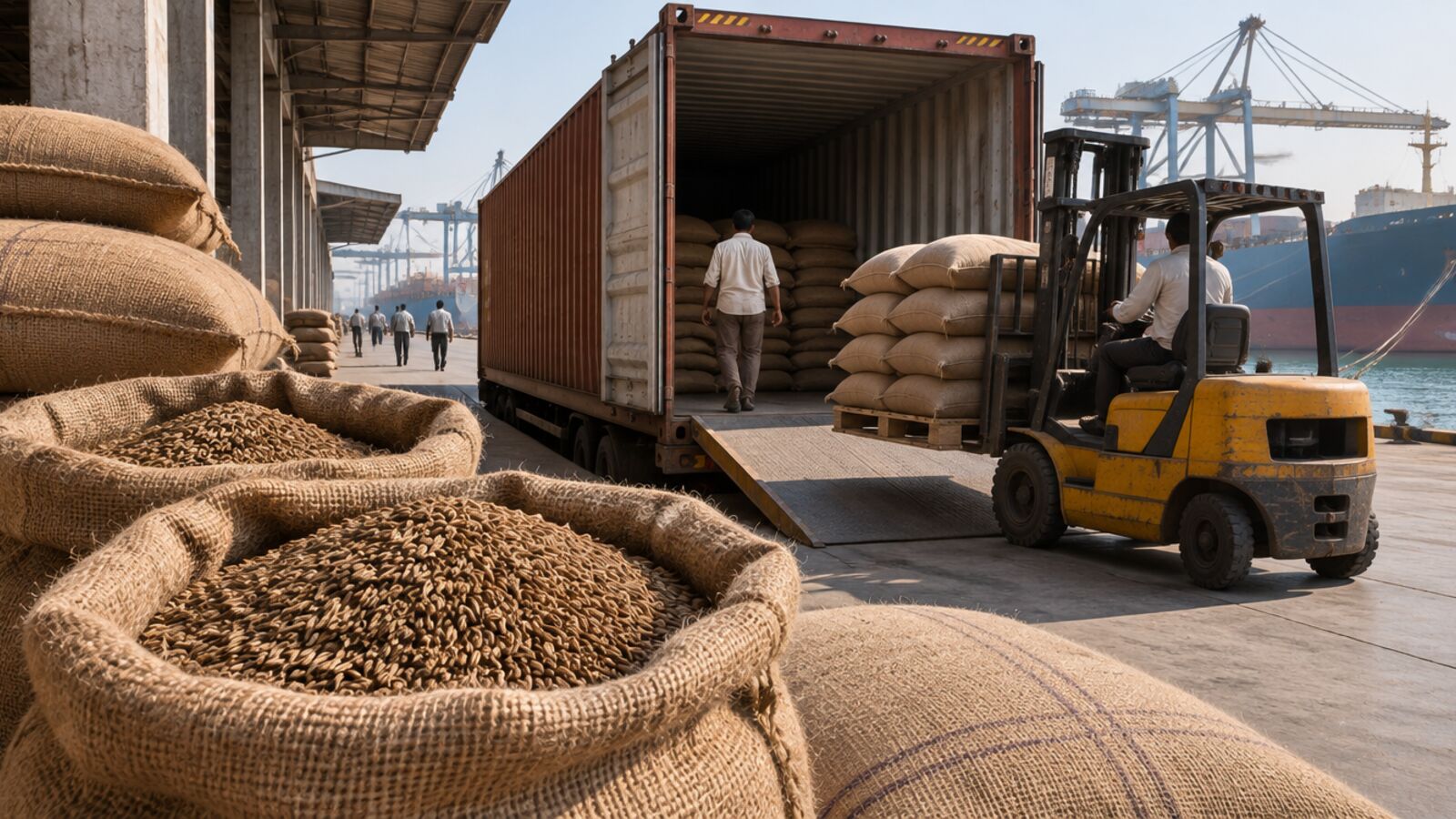
India's jeera (cumin) exports fell 14.39% to 196,800 tonnes in 2025-26 (April to March), from 229,881 tonnes in 2024-25, according to the Spices Board India item-wise export table compiled from DGCI&S data [1][2]. Export value fell 28% in dollar terms to US$524.22 million from US$732.35 million [1][3]. The single biggest cause was China, where Indian shipments dropped about 76% [4].
The fall matters because cumin is one of the few Indian spices whose export price is set largely by overseas demand. Jeera accounted for about 12% of India's US$4.43 billion spice export bill in 2025-26 (calculated from the Spices Board table) [1]. When a buyer the size of China steps back, the unsold seed stays in Gujarat and Rajasthan and weighs on Unjha prices and on the next sowing decision.
Value fell twice as fast as volume
The gap between the volume and value declines points to lower unit prices. Average realisation works out at about US$2.66 per kg in 2025-26 against about US$3.19 per kg a year earlier, a fall of roughly 16% (calculated from [1]). In rupee terms, earnings dropped about 25% to Rs 4,611.15 crore from Rs 6,178.86 crore, as reported by The Hindu BusinessLine and carried by Agronom.info [5]. An ICAR study using Spices Board country data puts the rupee decline at 25.37% [2].
Jeera was not alone. Total Indian spice exports fell 4% in volume and 6% in value in 2025-26, Informist reported from Spices Board data, with chilli and turmeric also lower [3]. But cumin's percentage fall in value was the largest among the major spices in that table [3].
China's own harvest removed a buyer
Exports to China fell to 9,271 tonnes in 2025-26 from 38,721 tonnes. The value of those shipments fell about 80% to US$22.81 million from US$114.51 million [5]. Yogesh Mehta of SpicExim told BusinessLine that China harvested a strong domestic crop of around 85,000 to 90,000 tonnes and so avoided heavy purchases from India [5]. The ICAR authors reach the same view, writing that China's good domestic harvest substantially reduced its import requirement [2].
The pullback was already visible in early 2026. BigMint reported that India shipped just 490 tonnes to China in January to March 2026, against 6,691 tonnes a year earlier [6]. Total cumin exports in that calendar quarter fell 35% to 29,801 tonnes [6].
| Destination | 2024-25 (t) | 2025-26 (t) | Change |
|---|---|---|---|
| Bangladesh | 30,515 | 29,579 | -3% |
| United States | 17,384 | 15,458 | -11% |
| China | 38,721 | 9,271 | -76% |
| Turkey | 967 | 7,529 | +679% |
| All destinations | 229,881 | 196,800 | -14% |
Sources: destination tonnages from Commodity Board (CMB News) [4]; totals from Spices Board India [1]. Percentage changes calculated.
Turkey and smaller markets grew but could not fill the gap
Turkey was the main exception. Indian shipments rose to 7,529 tonnes from 967 tonnes and value rose to US$19.61 million from US$3.33 million [5]. Traders cited soil-fertility problems in Turkey and a weak Syrian crop [5]. The ICAR paper also lists quantity gains to Israel (36.57%), Peru (25.50%), the Netherlands (19.37%) and Sri Lanka (15.13%) [2].
Those gains were small against the loss in China. Bangladesh, the largest buyer by tonnage, took less, as did the United States [4]. Shipments to Gulf Cooperation Council markets fell 4.14% in quantity and 17.21% in value. The ICAR authors link part of the weakness to freight, insurance and shipment disruption around the 2026 Iran conflict [2]. They caution that the data do not isolate the conflict as the sole cause [2]. Mexico (down 44.86%), Iran (down 26.32%) and the United Kingdom (down 13.27%) also fell [2].
The slide carried into 2026-27
Trade data for the new fiscal year show no turn yet. Commodity Board cited Spices Board figures showing jeera exports of 47,916 tonnes in April to June 2026, down about 24% from 62,861 tonnes [7]. A later Commodity Board report put April to July at about 53,462 tonnes, around 27% lower [8]. Kedia Advisory reported July 2026 exports of 9,318 tonnes, down 32% from 13,779 tonnes [9].
The latest figures extend the trend. Kedia Advisory reported on 26 November 2026 that April to September 2026 exports fell 24.6% to 82,935 tonnes and that average realisation fell 12.2% to US$2,527 per tonne [10]. September alone was 12,447 tonnes, down 27.4% [10].
These trade-press figures do not reconcile exactly. Kedia's July number added to the April to June total gives about 57,200 tonnes (calculated), more than the April to July figure in the later Commodity Board report [7][8][9]. Readers should treat the monthly 2026-27 numbers as provisional until the Spices Board publishes its own cumulative table.
What the trade is watching
The next signal is whether China buys again after its own harvest. Traders quoted in the BusinessLine report expected China to harvest another large crop and the Syrian crop to be larger, which would leave Indian exporters with less room [5]. They warned that weak exports could push farmers into other crops and leave India with higher carry-over stocks [5].
The rabi 2026-27 sowing now under way in Gujarat and Rajasthan is the other variable. A smaller Indian crop would tighten the exportable surplus even if demand stays soft. A larger one, with China absent, would add to stocks already built up through 2025-26.
Questions and answers
How much jeera did India export in 2025-26?
India exported 196,800 tonnes of jeera (cumin) in 2025-26, worth US$524.22 million, according to the Spices Board India export table [1]. That was 14.39% less by volume and 28% less by dollar value than the 229,881 tonnes shipped in 2024-25 [1][2].
Why did China buy less Indian cumin in 2025-26?
China harvested a large domestic cumin crop, put at around 85,000 to 90,000 tonnes by an Indian exporter quoted by The Hindu BusinessLine [5]. Indian shipments to China fell to 9,271 tonnes from 38,721 tonnes as a result [4][5].
Which countries bought more Indian jeera in 2025-26?
Turkey was the largest gainer, taking 7,529 tonnes against 967 tonnes a year earlier [4]. Israel, Peru, the Netherlands and Sri Lanka also took more, according to Spices Board data cited in an ICAR study [2].
Sources
- Spices Board India. Item-wise export of spices from India, 2021-22 to 2025-26 (source: DGCI&S, Calcutta / MoC; 2025-26 marked final), 2026.
- International Journal of Seed Spices (ICAR), Meena et al.. India's Seed Spice Exports amid Geopolitical Disruptions, Vol. 16(1): 69-79, June 2026.
- Informist. India FY26 spices exports decline 6% to $4.4 bln; volumes down 4%, 2026-06-03.
- Commodity Board (CMB News). Cumin Trade Under Pressure as India Faces Export Slump and Shifting Demand, 2026-08-03.
- Agronom.info, reporting The Hindu BusinessLine. Indian cumin exports drop sharply as Chinese buying slumps, 2026-06-21.
- BigMint. India: Jeera market weakens as export slowdown and rising arrivals pressure prices, 2026-04-14.
- Commodity Board (CMB News). Cumin Prices Hold Firm as Indian Export Slowdown Offsets Tight Syrian, Egyptian Supply, 2026-09-03.
- Commodity Board (CMB News). Cumin Market Firms as Indian Jeera Rallies on Tight High-Grade Supply, 2026-10-13.
- Kedia Advisory. Daily Spices Report, 30 September 2026, 2026-09-30.
- Kedia Advisory, via Investing.com India. Jeera Falls as Favourable Winter Weather and Soil Moisture Encourage Early Sowing, 2026-11-26.
Analysis by the India Spices Market editorial desk. For information only, not trading or investment advice.
Related
More from Intelligence.

Jeera
China's home-grown cumin cuts Indian shipments to 9,271 tonnes
26 November 2026 · 5 min read

Jeera
Turkey's purchases of Indian cumin jump nearly eightfold to 7,529 tonnes
26 November 2026 · 5 min read

Jeera
Gujarat jeera sowing at 74,278 ha, up 3.5% after last season's 14% drop
26 November 2026 · 5 min read
Read the market here. Meet it in Gandhinagar.
Every topic on this page is on the programme on 24 April 2027, with the people who move these prices in the room.
Registration opens 1 December 2026