Supply chain
Record-low rupee cushions spice export earnings but does not win sales
The rupee hit 96.97 per dollar in May 2026. It cushioned rupee earnings on jeera exports, which fell less than dollar earnings, but volumes still fell 14%.
Published · Data as of · 4 min read
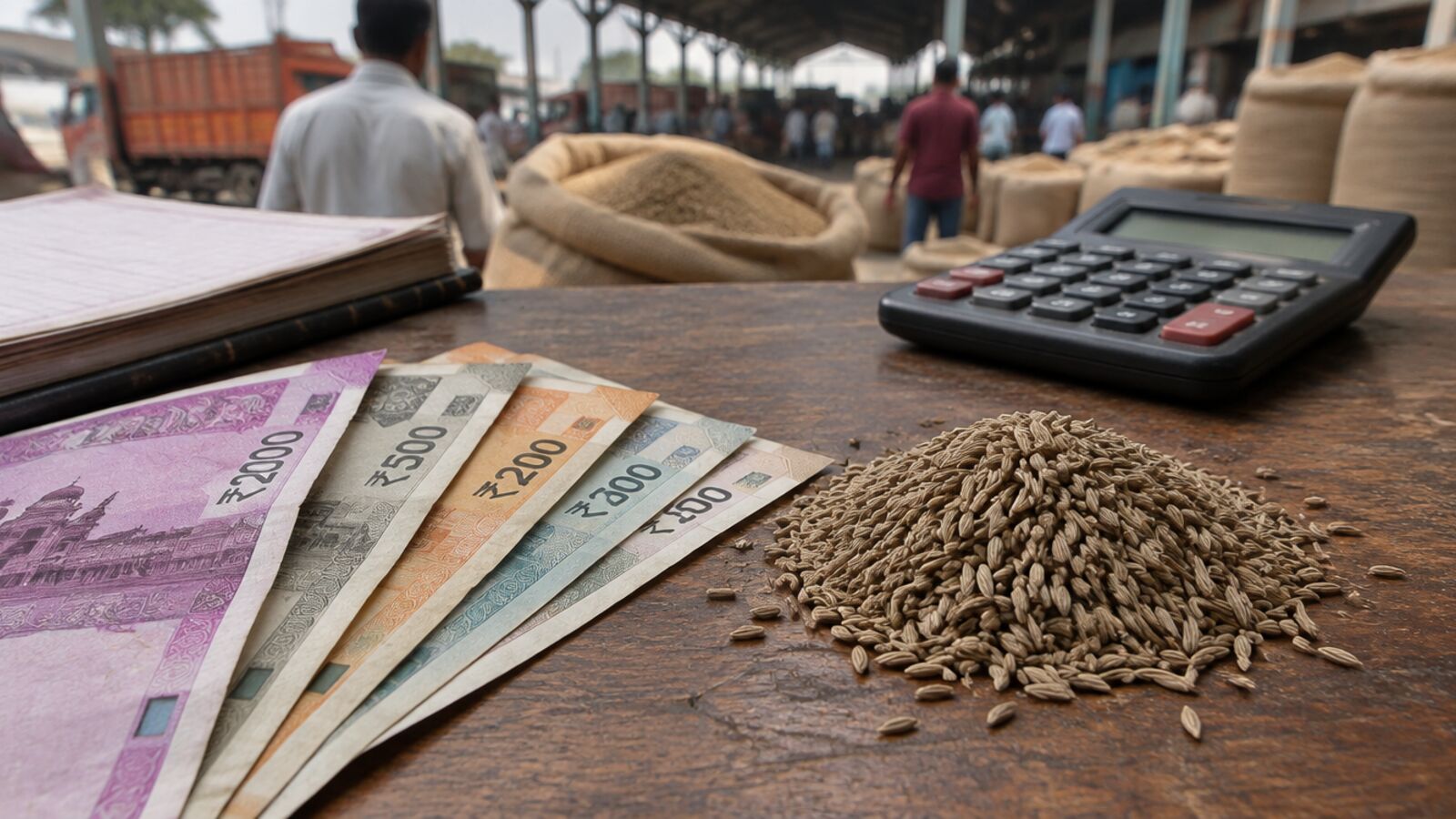
The rupee fell to a record low of 96.97 per US dollar in May 2026, Business Today reported. It was still near that level in early October [1]. It had recovered to 93.72 by 11 November, according to Kedia Advisory, which was about 4.7% weaker than the 89.49 close on 21 November 2025 (calculated) [2][3]. For spice exporters, the weaker currency softened the fall in rupee earnings but did not revive volumes.
The effect matters for jeera (cumin) and dhania (coriander) because Indian exporters sell in dollars or euros and buy from farmers in rupees. A weaker rupee lets them pay more at Unjha or Gondal for the same dollar price. They can also cut offers abroad without losing rupee margin.
The rupee cushioned 2025-26 cumin earnings
Spices Board India data show the gap. Cumin export value fell from US$732.35 million to US$524.22 million in 2025-26, a fall of 28%, but in rupees it fell 25% from Rs 6,178.86 crore to Rs 4,611.15 crore [4]. The implied exchange rate on those earnings rose from about 84.4 to about 88.0 rupees per dollar (calculated) [4].
| Measure | 2024-25 | 2025-26 | Change |
|---|---|---|---|
| Cumin unit value, US$ per tonne | 3,186 | 2,664 | -16.4% |
| Cumin unit value, Rs per quintal | 26,879 | 23,431 | -12.8% |
| Coriander unit value, US$ per tonne | 1,241 | 1,280 | +3.1% |
| Coriander unit value, Rs per quintal | 10,497 | 11,289 | +7.5% |
All values calculated from Spices Board India export volumes and values [4].
The weaker rupee did not stop volumes falling. Cumin exports dropped 14.39% to 196,800 tonnes as China's purchases collapsed [4][5]. Coriander exports were flat at 60,211 tonnes [4].
The pattern continued into 2026-27 even with the rupee near 96. Kedia Advisory reported that jeera exports fell 32% to 9,318 tonnes in July 2026 from 13,779 tonnes a year earlier [11]. Dhaniya exports fell 16% to 2,703 tonnes from 3,233 tonnes [11]. Its USD/INR reading on 30 September was 95.90 [11]. Currency weakness lifted the rupee value of each sale, but buyers abroad still bought less.
Analysts saw a boost to competitiveness
Trade analysts have pointed to the currency as a support. In May 2026 Kedia Advisory said the rupee's fall below 96.80 to an all-time low improved export competitiveness for jeera [6]. Its dhaniya report the same week said rupee depreciation near record lows improved competitiveness for Indian coriander [7].
The evidence on prices is mixed. Indian coriander remains far dearer than Egyptian seed in euro terms: on 31 October 2026 Indian 99.9% seed was offered at EUR 1.54/kg FOB New Delhi against EUR 1.08/kg FOB Cairo for Egyptian 99.9%, Commodity Board data show [8]. Indian 98% cumin was at EUR 2.28/kg FOB Unjha on 21 November [9].
Freight and demand weighed more
Others argue the currency is a weak tool in 2026. Sankar Chakraborti of Acuité Ratings and Research wrote in May that a weak rupee is "no longer a competitive advantage" because export realisations adjust with a lag while freight, fuel and war-risk costs rise immediately [10]. He said longer transit times for spices, tea and perishables were straining exporters' working capital [10].
The Reserve Bank of India has tried to slow the fall. It raised the repo rate by 25 basis points on 7 October, its first increase in nearly four years [1]. Forex reserves fell to US$734 billion in the week to 2 October from a record US$785 billion in early September, Business Today reported [1]. RBI governor Sanjay Malhotra said the rupee may be undervalued [1].
What exporters are watching
The first marker is the exchange rate itself: the rupee moved from 95.90 per dollar on 30 September to 93.72 on 11 November, Kedia Advisory's daily reports show [11][2]. A stronger rupee would squeeze exporters who sold forward at weaker rates. The second marker is the euro: Kedia put EUR/USD at 1.1167 on 11 November [2]. Most Indian seed spice offers to Europe are quoted in euros [8][9]. The third is whether the new crop arrives at lower rupee prices, which would matter more for competitiveness than the exchange rate.
Questions and answers
Does a weak rupee help Indian spice exporters?
It helps rupee earnings. India's jeera export value fell 28% in dollars but 25% in rupees in 2025-26, because each dollar earned more rupees. It did not stop export volumes falling 14%.
What was the rupee's record low in 2026?
The rupee hit a record low of 96.97 per US dollar in May 2026, according to Business Today. It was at 93.72 on 11 November 2026, Kedia Advisory reported.
Is Indian coriander competitive with Egyptian coriander?
Not on price alone. On 31 October 2026 Indian 99.9% coriander was offered at EUR 1.54/kg FOB against EUR 1.08/kg for Egyptian 99.9% seed, Commodity Board data show.
Sources
- Business Today (citing Bloomberg). Rupee near record low: why RBI's multiple defences are losing effectiveness, 2026-10-08.
- Kedia Advisory. Daily Spices Report, 11 November 2026, 2026-11-11.
- Business Standard. Rupee hits record low; slides to breach 89.5/$ amid trade uncertainty, 2025-11-21.
- Spices Board India. Item-wise export of spices from India, 2021-22 to 2025-26 (source: DGCI&S, MoC; 2025-26 final), 2025-26.
- Commodity Board (CMB News). Cumin trade under pressure as India faces export slump and shifting demand, 2026-08-03.
- Kedia Advisory. Jeera report as on 26 May 2026, 2026-05-26.
- Kedia Advisory. Dhaniya report as on 26 May 2026, 2026-05-26.
- Commodity Board (CMB News). Indian coriander edges higher while NCDEX futures correct from recent highs, 2026-11-01.
- Commodity Board (CMB News). Cumin under pressure: Indian selling weighs on prices as rabi sowing looms, 2026-11-26.
- Outlook Business (opinion, Sankar Chakraborti). Why the weak rupee is having selective mercy on exporters, 2026-05-11.
- Kedia Advisory. Daily Spices Report, 30 September 2026, 2026-09-30.
Analysis by the India Spices Market editorial desk. For information only, not trading or investment advice.
Related
More from Intelligence.

Supply chain
El Nino and dry soils slow rabi sowing in India's jeera and dhania belt
26 November 2026 · 4 min read

Supply chain
Monsoon 2026 ends 13% short, leaving dry soils for jeera and dhania sowing
26 November 2026 · 4 min read

Supply chain
Steam sterilisation and colour sorting become musts for spice exporters
26 November 2026 · 4 min read
Read the market here. Meet it in Gandhinagar.
Every topic on this page is on the programme on 24 April 2027, with the people who move these prices in the room.
Registration opens 1 December 2026